



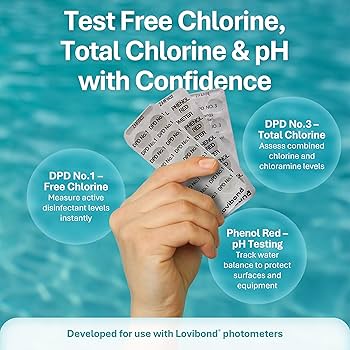

DPD tablets (diethyl-p-phenylenediamine) are chemical test reagents used for quickly and accurately measuring chlorine levels (free, combined, and total) and other disinfectants (like bromine, ozone) in water, crucial for pools, spas, and drinking water to ensure proper sanitation. Different DPD tablets (DPD 1, 2, 3, 4) are used in combination to differentiate between active (free) chlorine, bound (combined) chlorine, and total chlorine, helping users adjust disinfectant dosing for safety and efficiency.
How they work
- Reaction: The DPD chemical in the tablet reacts with chlorine in the water sample, producing a pink or red color.
- Measurement: The intensity of the color is measured using a color comparator or a photometer to determine the exact chlorine concentration.
Types of DPD tablets
- DPD No. 1: Measures free available chlorine, the active sanitizer.
- DPD No. 2 (with No. 1): Measures combined chlorine (chloramines).
- DPD No. 3 (with No. 1): Measures total chlorine (free + combined).
- DPD No. 4: Measures total available chlorine, often used in photometers for more precise readings.
Common uses
- Swimming Pools & Spas: To maintain safe disinfection levels.
- Drinking Water: To monitor residual chlorine.
- Industrial Water: For process water control.
Why they’re important
- Safety: Prevents disease by ensuring enough chlorine is present to kill pathogens.
- Efficiency: Prevents waste from over-dosing and health risks from under-dosing.